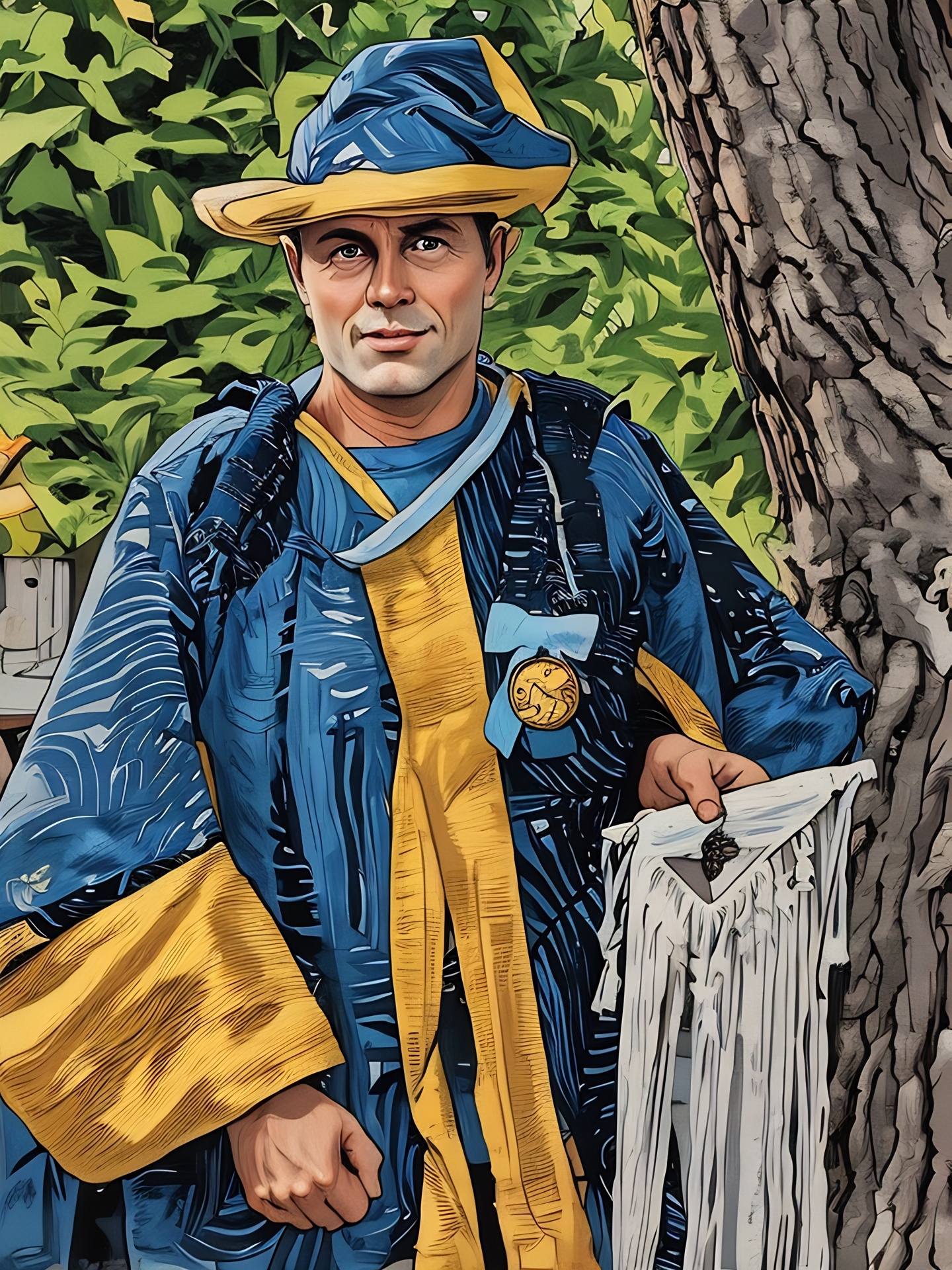
the Right High Eminent & Glorious Master Weaver; (RHEGMaW). Global Lead and Head of the Ritual Order of the Loom (ROoL)
The Loom was not a creation of the Dominion. It was an ancient device, older than the empire itself, raised by forgotten hands in an age when magic was whole. Across the world stood its towers and vast constructions, converging at the place that would one day become Sudenburg. This grand mechanism gathered the many ‘threads’ of magic , as the ancient texts of that kingdom record, into a single, living World Tapestry wrapped across the mortal realms like a protective layer of fabric.
But the Loom could not endure. In time, its vast power faltered, and the threads of magic unravelled. The threads of magic tore free and spilled across the lands, becoming unbound skeins, no longer bound in harmony. This catastrophe, remembered as the Shattering by those in the Dominion, changed the world forever.
The Dominion holds this moment as the reason it turned from trust in sorcery toward mastery of technology, seeking in steel and science the stability that the Loom had once promised through magic.
Where these skeins fell, they sank deep into the earth, the waters, and the air. Mountains rose where they struck, rivers bent their course, and forests grew wild and strange. Their presence scarred the land, but also left behind places of power, sites where the raw source of this world force lingers strongest. These are wells of potential, revered by some as sacred and feared by others as cursed. Priests build shrines upon them, mages seek them out for ritual, and common folk tell stories of blessings and monsters born in their shadow. Yet within the Abandoned Lands*, they are rumoured to be abundant for some reason, for better or worse is still argued. To draw upon a skein is to taste unfiltered power, but it is also to invite danger, for the strands are unstable and unpredictable.
The Dominion teaches that these scattered skeins are not gifts but reminders, shards of a broken order, fragments of the Loom’s ruin that can never again be fully bound. They are lessons written into the very land: a warning of what happens when mortals place their faith in the false stability of magic.
The Shattering did not simply damage the Loom, it changed the nature of power itself. No longer neatly woven, the threads of creation now bleed into the world in unpredictable ways. Where once magic and faith were distinct paths, the Dominion teaches that they are, in truth, drawn from the same fractured force, and so both are to be regarded with caution, for neither can as be fully trusted as the glory of cold technology.
A mage who channels the elements and a priest who kneels in devotion both tap into the same. It is often argued that one seeks mastery, whilst the other seeks meaning, but both risk the dangers of what is known as ‘Consequence’, a force of the world that truly shows that the skeins remain fragile and volatile since the Shattering.
Many years passed, the world was torn by war and famine but the loom emerged from the hate. I developed my mind and body, being at one with all I was, a woven work of love and hart, joy and fear, war and creation…
Skjor the Knight was a man of contrasts. By day, his plate armor gleamed with a burnished sheen, and the clang of his sword on the training ground was a testament to his martial prowess. But when the day’s duties were done and the castle fell silent, Skjor would disappear into his modest chambers, where the scent of polished steel gave way to the earthy aroma of chamomile and fresh linen.
He had not been born to the sword. The son of a respected village weaver, Skjor’s early years were spent amidst the rhythmic thrum of the loom and the rich hues of natural dyes. His hands, though capable of gripping a broadsword with strength, were just as adept at the delicate dance of a shuttle and the precise twist of a thread. The intricate patterns he wove told stories of the natural world, a world he came to know intimately.
It was this weaving that led him to herbalism. Seeking more vibrant and lasting colors for his threads, he ventured into the nearby woods, guided by a local wise woman. She taught him to recognize the potent magic held within every leaf and root. From woad for deep blues to madder for fiery reds, he learned to extract not just pigment, but the very essence of the plants. Soon, his knowledge extended beyond dye-making. He began to learn of poultices for wounds, infusions for fevers, and calming teas for troubled minds.
When his village was threatened by a rampaging brigand, Skjor’s weaving loom was pushed aside for a shield and sword. He fought with a quiet ferocity, not out of a love for battle, but for the protection of his home and the people he cherished. His valor earned him the favor of the local lord and an offer of knighthood. Skjor, who had always valued peace over conflict, hesitantly accepted, hoping to use his new position to protect the innocent.
As a knight, Skjor’s secret passions became his greatest strengths. When a fellow knight was injured by a poisoned arrow, the castle’s mediciners were baffled. Skjor, however, recognized the plant’s toxicity from his herbalist’s lore and was able to concoct an antidote that saved the knight’s life. During long sieges, when morale was low, he would gather wild herbs to brew soothing drinks for the exhausted soldiers and weave tapestries depicting tranquil forest scenes to remind them of the peace they were fighting to preserve.
Some of the other knights mocked him for his simple home-craft hobbies. They did not understand how a man could be a warrior and yet find solace in the rhythm of a loom and the fragility of a wildflower. Skjor never rose to their taunts. He knew that true strength lay not only in the ability to destroy but also in the power to heal and to create. He was a knight who knew the weight of a shield and the lightness of a linen thread. He understood the violence of a sword and the quiet persistence of a root pushing through soil. He was a protector not just of his kingdom, but of the gentle, healing world that lay just beyond the castle walls.
A knight known as Skjor, lean and tall,
Made tapestries for the castle wall.
He’d brew healing tea,
For any malady,
And soothe sick squires, and stand up to them all.
The Traditional History
Long ago, before the wind carved songs into the hills and before the stars had names, there lived an old woman in a moss-covered cottage at the edge of the Whispering Highlands. Her name was Aelra, and she was known only by the few who dared wander that far north as The Weaver of Threads.
Her loom was unlike any other—built from the roots of the World-tree itself, polished with mountain honey, and strung with threads spun from moonlight, spider silk, and the first snowfall of winter. The villagers whispered that Aelra was not entirely of this world. Some said she was a witch. Others said she was the last of the Fae who stayed behind when the veil between worlds thinned and cracked.
But one thing all agreed on: Aelra wove destinies.
Each night, beneath the breath of the northern winds, she would sit before her loom and weave. The clack of her shuttle echoed through the hills like distant hoofbeats. The patterns she made were not just beautiful; they pulsed with life. Silver lines curved into constellations. Crimson knots became storms. Golden spirals birthed kings and queens, lovers and liars.
It is said that if you watched closely, you could see people being born and dying in the threads. The loom did not lie. It recorded all that was, is, and could be.
Many tried to seek Aelra out to change their fates. A boy once climbed the cliffs barefoot in the snow to beg her not to weave his mother’s death. She listened kindly and handed him a small swatch of cloth, warm and still humming with thread-light. “Some patterns cannot be undone,” she whispered, “but they can be softened.”
Another time, a warlord came with fire and iron, demanding to see his future. Aelra showed him a tapestry that ended in a blank space, frayed at the edges. Enraged, he struck the loom with his sword. The wood bled sap and screamed. That winter, his army vanished in the snows, leaving not even bones behind.
The loom, it was said, could not be destroyed. Nor could its weaver be forced. Years passed. The hills forgot the warlord and the boy and even Aelra. But the loom remained.
One morning, the villagers awoke to find the skies burning violet and the rivers flowing backward. The stars had changed their courses, and no birds sang. The elders climbed the hills, fearing the end of the world. But when they reached the cottage, they found it empty. Dust hung in the air like sorrow. The loom stood still, the last thread dangling unfinished.
A young girl from the village, curious and brave, stepped forward. She touched the loom—and it stirred. It hummed a song older than language, and in that moment, the girl understood: Aelra had passed her gift on. And so, the world continued.
To this day, hidden deep in the Highland mists, the loom still weaves—sometimes fate, sometimes mercy. And somewhere, a weaver sits in silence, pulling the threads of time through her fingers, deciding which tales to end… and which to begin.
“The Ritual of the Loom” — A Ceremony of Interconnection
Opening
Master Weaver: Says “We gather at the Loom — not to make cloth, but to remember that we are cloth: each thread distinct, yet held together by tension, patience, and purpose.”
Loom Steward lights the lamp or candle.
Master Weaver: Says “ This light stands for awareness — the spark that shows us how each thread touches another. Let us begin by grounding ourselves. (All take a breath together.)
Part I – The Warp (Foundations)
Warp Keeper: Says “These are the warp threads — the vertical lines of constancy. They represent our values, our ethics, and the unseen structure of our days.” (Warp Keeper runs fingers along the vertical threads of the loom.)
Master Weaver: Says “Without the warp, no weaving holds. Without principle, no community endures.” (Moment of silence.)
Part II – The Weft (Connection)
Weft Bearer: Says “I carry the weft — the threads that cross from one to another, over and under, back and forth. These are our actions, our relationships, our shared stories.” (The Weft Bearer begins to pass a coloured thread through the warp.)
Master Weaver: Says “Each crossing is a moment of contact — a decision, a kindness, a memory. Let each of us now add a thread to this weaving.” (Each participant chooses a coloured thread, names aloud or silently something or someone they are connected to, and weaves it through the loom. – Then are presented with medal of the Ritual Order Of the Loom)
Part III – The Knot (Integration)
When all threads are woven: Loom Steward: Says “ The weaving grows dense. The pattern begins to speak. “
Master Weaver: Says “The knots that secure our threads may not be beautiful, but they are strong. They remind us that imperfection binds us more deeply than polish ever could.” (Participants gently tie or tuck in loose ends.)
Part IV – Reflection
Master Weaver: Says “ Look upon the cloth. Each colour tells a story, each crossing holds a life. None could exist alone — each depends on the tension and care of the others.” (Pause for silent reflection or shared words.)
Closing
Warp Keeper: Says “The loom rests, but the weaving continues — in conversation, in community, in every choice we make.
Master Weaver: Says “May we leave this space mindful of the invisible threads between us, and weave our days with intention, compassion, and light.
The Loom Steward extinguishes the lamp or candle.
All Together: says (lead by the Master Weaver) (repeat after me) The cloth remains. (repeat after me) So may our connection.
END OF PAGE